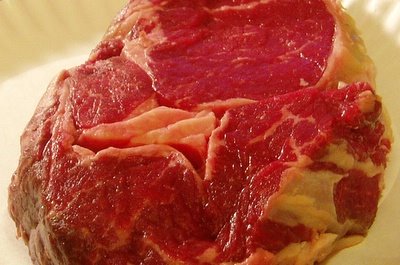
 "Isn't steak supposed to be a man's job?" said Jason after chewing through a piece of practically raw meat. "How about *I* make us steak tomorrow?" he suggested with a devious smile. It's not often he gets sexists on me or makes fun of my cooking disasters. If the situation would not be completely absurd, I would consider being offended, but we both just couldn't stop laughing as I put the unfortunate rib-eye into the oven for the third time.
To understand my steak saga, you have to understand an awful lot about me and about meat. I love a really great steak about 4 times a year. Any more than that and I get bored with beef, start gaining weight, and just don’t feel too good. But, cooking steak 4 times a year is hard on all accounts. Can you imagine the expectations? When I actually decide to cook steak, I want nothing but perfection. Well the perfection is hard to achieve when you cook steak once in 3 months. I find that there is a certain mystique around the concept of steak. I might make braises like boeuf bourguignon or osso bucco only once a year and they are perfect every time. But when it comes to cooking meats to medium-rare, I am in trouble.
Just buying the right steak is a challenge. You have to know the difference between choice and prime, grass-fed and grain-fed, wet-aged and dry-aged. Then you have to decide between tenderloin, rib-eye, T-bone, NY strip, hanger, skirt, etc. Which one is most tender? Which one is most flavorful? Which one is the best of both worlds?
Then there is the cooking temperature. Some people swear by high, some by low, some by high followed by low. There isn’t even agreement on how long to rest the meat. Opinions range from 2-10 minutes and from uncovered to tightly wrapped with foil and kitchen towels. Testing for doneness is the worst. It’s so easy for fish, separate the flakes, peek inside, and if only a trace of translucency remains, it’s done. The debates about doneness for steak are intense enough to start a religious war. Anywhere from 120F to 150F can be considered “medium-rare” depending on what you read. And how to test for this temperature is even more divisive. I used to be huge fan of instant read thermometers until the disaster last night. When I put the steak in the oven with a thermometer stuck into it sideways, I got a faulty reading due to my thermometer touching the side of the pan.
“You have it easy!” I told Jason. “You’ve seen me make every possible steak mistake. Of course, your steak will come out better.” To tell you the truth, I sure hope it comes out better because I want this steak saga over with. We’ve been eating steak twice a week for the past two weeks and I am just sick of it, particularly that it wasn’t that great. But I just can’t give up on this steak quest. The engineer in me is determined to reduce this black art of steak cooking to a simple process that can be followed by anyone and doesn’t require eating steak on regular basis to master.
Although I shouldn’t be helping my opponent, I’ll be generous, and share a few lessons I’ve learned so far. Jason, read carefully.
1) Rib-eye is a good compromise between tenderness and flavor. I don’t understand the hype about NY strip. I find it chewy and too dense.
2) Grass-fed beef tastes the best – most juicy, flavorful, and tender. It doesn’t really make sense since it’s leaner than grain-fed beef, but so far it’s been the winner.
3) Cooking steak on high heat the whole time makes it tough and unevenly cooked. Start out as high as possible to sear the outside, then finish in the oven.
4) When you put the steak in the oven, turn in half way through total cooking time. The pan is still hot from searing and the side of the steak that’s touching the pan will cook faster.
5) The oven temperature is still a mystery to me. I have a feeling that 250F for a long time, would result in the most tender steak, but I haven’t tried it yet, so I can’t say anything about the timing.
6) Don’t listen to Alton Brown about the estimated cooking time – that’s how we ended up with raw meat for dinner last night.
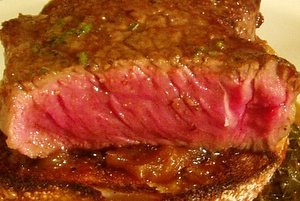
1-1/2 inch steak cooks longer than 5 minutes (1 minute sear + 4 minutes oven) that Alton suggests. My best estimate based on my previous mistakes is at least 9 minutes (1 minute sear + 8 minutes oven). I hope to come up with an estimated cooking time formula some day like I have for fish. My best guess so far is 6-8 minutes in 500F oven per inch of thickness for medium-rare.
7) How do you know when it’s medium-rare? I don’t know exactly what works yet, but I know what doesn’t. Rule of thumb is complete BS. People like it so much because it’s cute. Even our instructor at CIA thought it was completely unreliable. Does meat get tougher when it cooks? Absolutely. But a medium-rare rib-eye will feel differently than a medium-rare tenderloin or hanger steak, and how does all that correspond to your thumb is a mystery to me and most professional chefs that I asked. When chefs poke meat to test it for doneness, they don't compare it to their thumb, but to how equivalent piece of meat felt last time they cooked it to that doneness. When you make 20 steaks per night you can develop that kind of intuition, but for someone who cooks steak 4 times a year, it's simply hopeless.
8) Theoretically, thermometer is a foolproof way of testing meat for doneness, unless you don’t stick it perfectly in the middle or a part of the probe touches the side of the pan, or the high tech equipment gods just aren’t with you. If using a thermometer don’t stick it into the meat and then put it in the oven. Even thermometers that are oven safe only do it well for large roasts.
9) I know it’s against all the conventional wisdom, but I don’t see anything wrong with making a small slit in the steak and peeking inside. I am guessing that if you want your steak medium-rare, you should take it off the heat when it’s rare. The very center should still be purple and raw looking. I haven’t tried this yet due to everyone’s concerns about lost juices, but the argument doesn’t make any sense to me. Do meat juices travel horizontally through the whole steak and leak out in the place where you made a cut? I don’t think there is much you can do about the loss of juices. People wish they could do something about it and they keep making up juice saving theories, like “sear the steak to seal in the juices” or “don’t make any cuts in the meat.” We have scientific evidence that the first statement is plain wrong and I wouldn’t be surprised if the second one is too. The reason you let the meat and fish rest is to even out the temperature. When you get it out of the oven, the outside is at 500F and the inside is at 120F. That’s just not a very good situation from the taste standpoint. Once you let it rest, the outside will cool and inside will warm up giving you a perfect 130F throughout.
10) After taking the steak off the heat, remove it to a warm plate, cover steak tightly with foil and two layers of towels. This will retain as much heat as possible and help with the final temperature stabilization.
Can't think of anything else at the moment...
Ok, man – show us how it’s done.


 "What are
  The time has finally come for the full disclosure. There was another reason I was quiet these couple of weeks. Registering people for classes and working on my winter teaching schedule surely kept me busy, but there was something far more engulfing and top secret than cooking classes. What was this undercover operation that had been occupying all my thoughts during the last few weeks? It was Jason's 30th birthday party.
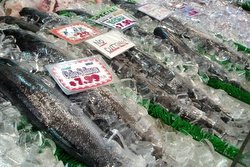
  I’ve been absent from Beyond Salmon for so long, you’d think I was gone on another vacation. I wish! But nope, no more vacation for me. I’ve simply been too busy teaching and working. Last Saturday, I lead my first fish market tour in East Cambridge. Those East Cambridgians are a spoiled lot – I’ve never seen this many great fish markets per square mile.
 What do you do when you find yourself in a really yummy city like Vancouver? Any reasonably food-obsessed person would carefully prioritize the restaurant choices, make reservations, ask waiters for dishes not to be missed, and try to squeeze in as many optimal meals as possible. To help narrow down the restaurant list, I wrote to Mark Busse, the creative brain behind
 Meeting Mark’s friend Colin, during our dinner at
 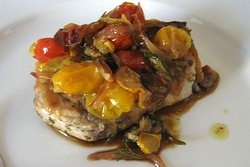 We started with marlin and roasted summer veggies paired with Dr. Loosen Riesling. Jason tried to choose a wine to match the sweetness and tang of roasted cherry tomatoes and it worked like a charm. I got so caught up in talking that I overcooked the fish a bit, but the saucy veggies came to the rescue.
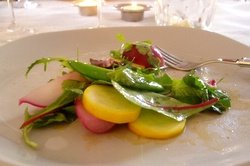 Next came a salad with summer squash, snap peas, and radishes. I was wondering what the secret to Colin’s dressing was. Honey. As Kristil told us over dinner, Colin takes honey very seriously and has quite a collection.
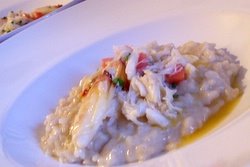 The lobster risotto topped with local dungeness crab and beurre blanc was to die for. I picked up a great tip from Colin for separating the grains and giving risotto a light and creamy texture – fold in some whipped cream right before serving. I also learned that Viognier is a fantastic match for crab.
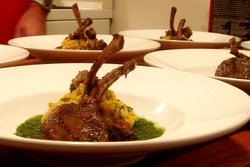 Next was the rack of lamb that Mark so carefully trimmed and marinated in his office kitchen. Doesn’t everyone have a little test kitchen in their office? It was served with a watercress puree and olive crushed potatoes and paired with a BC pinot noir and a Spanish Campo di Borja Crianza. Now, how often do you get to try two wines with a dish? The lamb was from an island off Vancouver coast. Those Vancouverites are lucky to have lamb this tender and juicy and Mark’s marinate of vodka and cherries was simply fabulous.
 For dessert, Colin intended to make a tart with rosemary custard and figs, but the dough wouldn’t cooperate. Having years of experience with baking disasters, I suggested we crumble it up and sprinkle on top of fruit. Colin added a creative twist to this idea and made parfaits with layers of fruit, custard, and buttery crumbs. Paired with Okanagan valley dessert wine, that Andrea brought from her recent trip, it was a sweet ending to a fantastic meal.
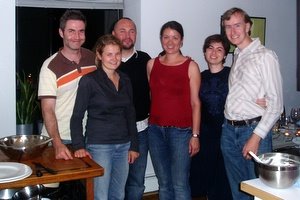 We’ve discovered Vancouver’s best kept secret – Colin’s kitchen. It was the most memorable meal of our vacation -- not only because the food was great, but because it was prepared from the heart. These guys’ passion for their beautiful Vancouver was contagious and we could taste it in every bite. We hope to do this again soon, this time in Boston.