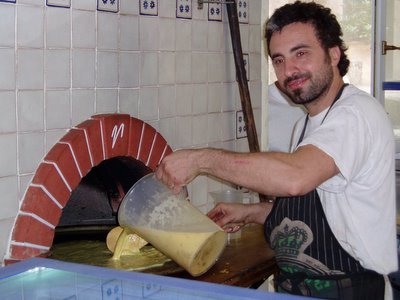
 You see that guy… You know why he is smiling? Not only does he live on the gorgeous Italian Riviera, but he is about to create one of the most delicious street foods of all time.
Before my trip to Italy, I had strict instructions from my well-traveled friends to try Ligurian pesto, seafood, and focaccia. Why didn’t anyone mention farinata? I’ve never even heard of it before going to Liguria.
When we walked into the first pizza shop in Vernazza on our hike through Cinque-Terre, we were literally moonstruck by a huge yellow pancake! Its crispy edges were begging to be eaten, but I didn’t know if we can handle eating this whole moon – it was 2 feet in diameter! Lucky for us, another lady walked into a shop and asked for “farinata.” Swoosh! A half circle was cut off the moon’s edge and handed to her. Aha, we could just get a piece of the moon! I followed in her footsteps and asked for farinata too. Swoosh! And I got my piece.
It was crispy on one side and delicate on the other, thicker than a crepe, but thinner than a pancake, very simple, yet absolutely heavenly. As soon as I swallowed my first bite, my reverse engineering brain set to work. It was definitely not wheat. Maybe corn – it had that golden color, but the texture was much finer, not as gritty. I’ve never had anything quite like it. I don’t think astronomers get as excited about discovery of new stars, as I get excited about discovery of new pancakes.
I was not too worried about never tasting farinata again, until I got back to the US and couldn’t find it in Marcella Hazan cookbook. I count on Marcella for all my Italian cooking needs – fresh pasta, grilled whole fish, pork braised in milk. How could she omit such a delicious part of Ligurian cuisine! I searched all my reliable web recipe sources. Nothing. After googling for “farinata” I found out that it was made out of chickpea flour (not corn!), but still no recipe. “I guess I’ll have to go back to Liguria someday,” I thought.
Imagine my surprise when I was reading chowhound home cooking board more than a year after my trip, and saw a post from Nick with Mark Bittman’s recipe for farinata. After a quick stop at the Whole Foods for chickpea flour, I was on my way to recreating the dish I missed all year. It was just as good as in Liguria – crispy, delicate, and absolutely addictive. But even though I can now make farinata, I’ll still have to go back to Liguria someday.
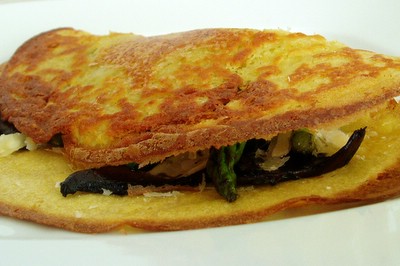
Farinata
(adopted from Mark Bittman’s recipe in the New York Times)
I used Bittman’s recipe almost as is, but instead of pouring all the batter into the skillet at once, I baked it in batches to make several thinner pancakes rather than one thick one.
1 cup chickpea flour
1 3/4 cup lukewarm water
2 tsp kosher salt (or to taste)
2 Tbsp olive oil plus more for cooking
- Whisk chickpea flour, salt, and water until no lumps remain. Whisk in 2 Tbsp olive oil. Cover and set aside at room temperature overnight.
- Preheat oven to 450F.
- Put a well-seasoned cast iron (or non-stick) skillet in the oven to warm up for 5 minutes. Add a little olive oil to the skillet and return to the oven for 2 more minutes. I use about 2 tsp oil for a 10 inch skillet (adjust this amount if your skillet is of a different size).
- Whisk the batter well before using. Pour in enough batter to cover the bottom of the skillet and form 3mm thick layer (about 3 times the thickness of a crepe). The batter will sizzle. Place the pan in the oven, and cook until the pancake is dry on top and solid in the center when you nick it with a knife, about 12 minutes.
- Carefully remove farinata to a plate, add more oil to the pan and repeat with the rest of the batter. Serve as soon as farinata is out of the pan, or put on a cookie sheet in one layer and warm up in the oven after you finish the batter.
- Cut into wedges and serve as a snack. Or fill with all kinds of savory goodies like a crêpe. I don’t know if filling it with stuff is authentic, but it was certainly yummy.


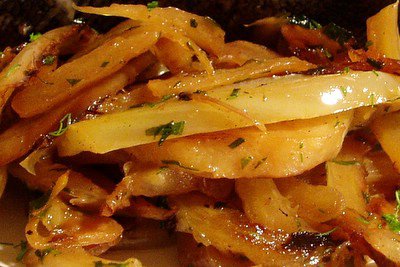
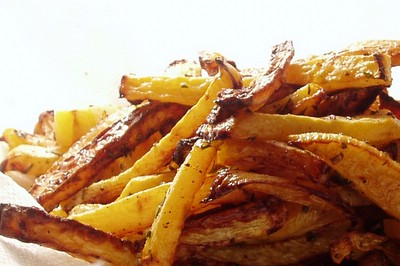 I always get terribly excited about discovering a new vegetable, particularly a vegetable that I can roast. Roasted veggies are one of my food addictions. They are also the most reliable trick for converting picky eaters into lovers of turnips, cauliflower, beets, and other challenging veggies.
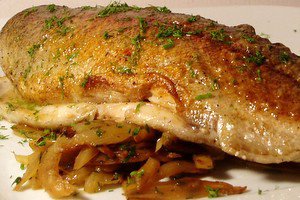
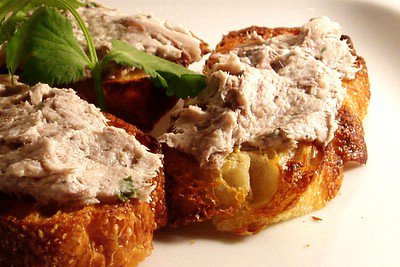 When a bluefish tail was leftover after yesterday's cooking class, I knew it would find a good home in some dish the next night. Any fish leftovers are good, but bluefish leftovers are so good that I sometimes cook bluefish just to have leftovers. The trick to dealing with fish leftovers is to give up the idea of reheating them. Reheated fish does not taste nearly as good as all the delectable things you can make out of it, like crêpes, tacos, burgers, salads, and pâtés. And no fish plays this reusable role more admirably than bluefish. If there were Fish Academy Awards for the best leftover fish, bluefish would definitely win one. Its velvet texture is perfect for any mashed up preparation, and its flavor stays pronounced even when it's cold.
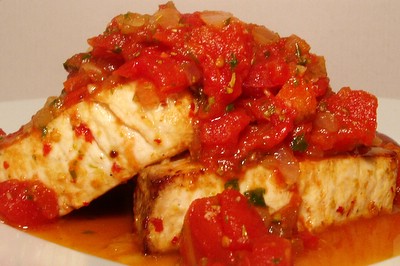 I know what you are thinking -- Helen hasn't cooked fish for ages. I admit that I've been bad about posting fish recipes lately, but that's not for lack of cooking. In fact, I've made 7 fish dishes in the past 4 days. Don't worry, I am not eating fish for breakfast, lunch, and dinner. I am just in the middle of a very busy cooking class semester. The unfortunate thing is that it's hard to teach a cooking class and take mouth watering pictures. The lighting in these places is not great. Besides, I don't want to freak my students out by taking pictures of everything I cook. They think I am pretty geeky about food as it is. Luckily, I just found a picture of Swordfish Provençal that I took couple of months ago. This isn't the most photogenic dish even under the best conditions, but it is usually my students' favorite. Try it -- you'll like it :)
 I got tagged by Raquel from
 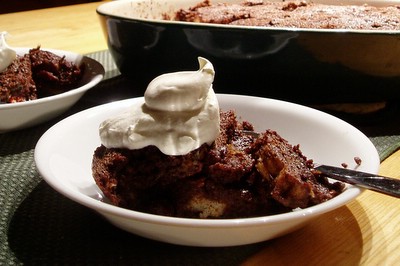 Two years ago, when I got "The Way We Cook" book by Sheryl Julian and Julie Riven, I doggie-eared Perdix's chocolate bread pudding page. "Oh yeah -- I should make it soon!" I always thought when leafing through the book, but the occasion never presented itself. Either it was summer and bread pudding seemed too heavy, or it was a special occasion and bread pudding seemed too homey, or some ripe fruit were begging to be used in a pie (I am much more of a fruit than a chocolate dessert person). But finally, the chocolate bread pudding had its day. What better occasion for this decadent dessert than a skiing trip!
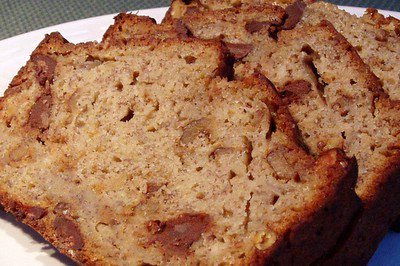 Part 1 – The Quest for the Perfect Banana Bread
 “Wow, that’s so rich!” said Louise as she tasted another one of my creations – butternut squash and hazelnut lasagne. We were deliciously achy after a day of snow shoeing, having dinner to the sound of the crackling fire and Madeleine Peyroux, enjoying each melty forkful of the creamy béchamel that ended with an earthy crunch of hazelnuts.
 Remember my recent